Moving looks simple from outside pack items, load truck, shift. But in India, reality is different. Goods travel through multiple hands, rough roads, weather changes, and sometimes careless handling. That is where moving insurance becomes important not as a luxury, but as a practical safety layer.
This blog explains the real cost, types, and full process of moving insurance in simple terms.
What is Moving Insurance?
Moving insurance is a temporary protection cover for your goods during shifting-from packing to final delivery.
It helps you recover money if something goes wrong like:
- Damage during loading/unloading
- Road accidents
- Theft during transit
- Fire or natural issues like rain or flood
Strong POV:
In India, shifting is not a controlled system like in developed countries. Too many variables exist. So thinking “nothing will happen” is more risky than paying a small premium.
Types of Moving Insurance in India
1. Carrier Liability (Basic Cover)
- Given by transporter (often free)
- Very limited compensation
- Usually based on weight, not value
Reality: This is not real insurance. It’s just formality.
2. Transit Insurance (Named Risk)
- Covers specific risks like accident, fire, collision
- Does NOT cover handling damage in many cases
Good for budget users, but still risky.
3. All-Risk Insurance (Full Protection)
- Covers damage, theft, mishandling, and more
- Most recommended option
If you have electronics, furniture, or valuables-this is the only practical choice.
Cost of Moving Insurance in India (2026)
Average Cost Range
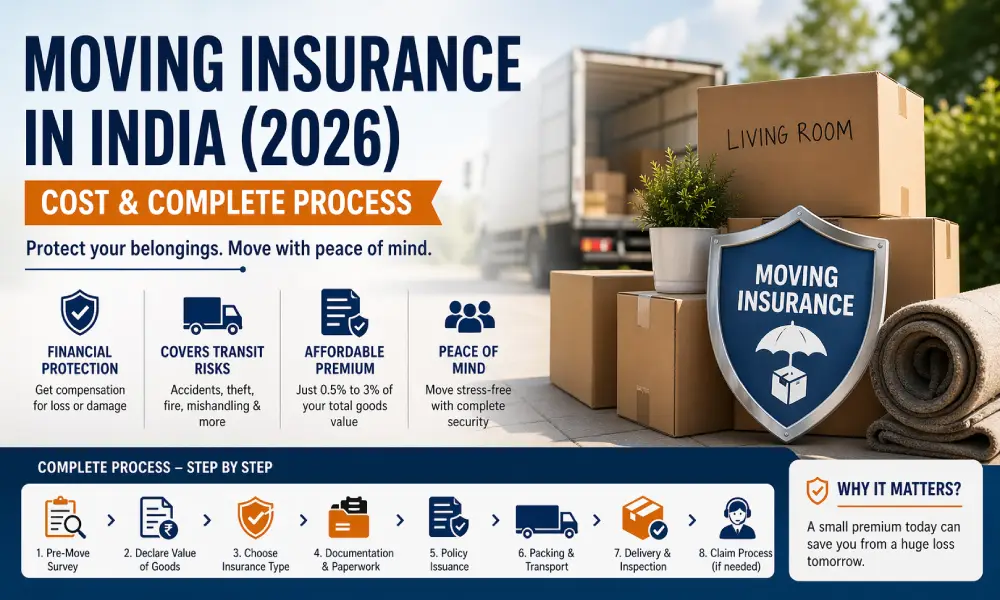
- 0.5% to 3% of total goods value
Example
If your household value = ₹5,00,000
- Insurance cost = ₹2,500 to ₹15,000
What Affects Cost?
- Value of Goods
Higher value = higher premium - Distance
Long-distance shifting = more risk = higher cost - Coverage Type
- Basic → cheaper
- All-risk → slightly expensive
- Route Risk & Season
Monsoon or remote areas increase cost
Insight:
Most people try to save ₹2–5k here, but a single damaged fridge can cost ₹20k+. So saving on insurance is often a false saving.
Complete Process of Moving Insurance
Step 1: Pre-Move Survey
Mover checks your items and gives estimate
Step 2: Declare Value of Goods
You list items and assign value
- Electronics
- Furniture
- Appliances
Important: Wrong value = claim problem later
Step 3: Choose Insurance Type
- Basic / Transit / All-Risk
Step 4: Documentation
You need:
- Inventory list
- Invoice or estimated value
- ID proof
- Moving receipt
Step 5: Policy Issuance
Insurance document is generated before shifting
Step 6: Packing & Transport
Goods are packed and moved
(Proper packing is important-bad packing can cancel claims)
Step 7: Delivery & Inspection
Check items immediately after delivery
Step 8: Claim Process (if needed)
- Inform within 24 to 48 hours
- Submit photos/videos
- Provide bills and proof
Claims are approved based on policy terms and proof
What is NOT Covered
Most people don’t read this part and face issues later.
Not covered:
- Old damage
- Normal scratches
- Poor packing
- Mechanical failure
Truth: Insurance companies pay only when rules are followed.
When Should You Take Moving Insurance?
Take it if:
- You are shifting to another city
- You have expensive items
- You are using third-party movers
Avoid (maybe) if:
- Small local shifting
- Very low-value items
Practical Tips (Real Experience Based)
- Always take photos before packing
- Keep bills of expensive items
- Don’t under-declare value
- Ask clearly: “Who is insurer?”
- Check GST invoice (avoid fake policies)
Biggest mistake: trusting verbal promises from movers
Final Thought
Moving insurance in India is not about fear-it is about control.
You cannot control roads, labour, or accidents.
But you can control your financial risk.
FAQs
1. Is moving insurance mandatory in India?
No, it is not mandatory, but strongly recommended, especially for intercity moves.
2. How much should I insure my goods for?
You should insure close to actual market value. Under-insuring can reduce claim amount.
3. How long is moving insurance valid?
It is valid only during transit-from packing to delivery.
4. Can I buy insurance separately from movers?
Yes, you can take it directly from an insurance company instead of relying on movers.
5. What is the safest insurance type?
All-risk insurance is the safest and most complete option for most people.